
Rubik’s Cube Notation: Complete Guide .

Learning Rubik’s Cube notation is one of the most important steps for anyone who wants to solve the 3×3 Rubik’s Cube, learn advanced methods, or improve their solving speed. Cube notation provides a universal language for describing Rubik’s Cube moves, algorithms, and solving techniques.
Whether you are a beginner learning your first algorithm or a speed cuber practicing advanced CFOP techniques, understanding cube notation makes it much easier to follow tutorials and remember algorithms.
What Is Rubik’s Cube Notation?
Rubik’s Cube notation is a standardized system of letters and symbols used to describe how to turn the different faces of a Rubik’s Cube.
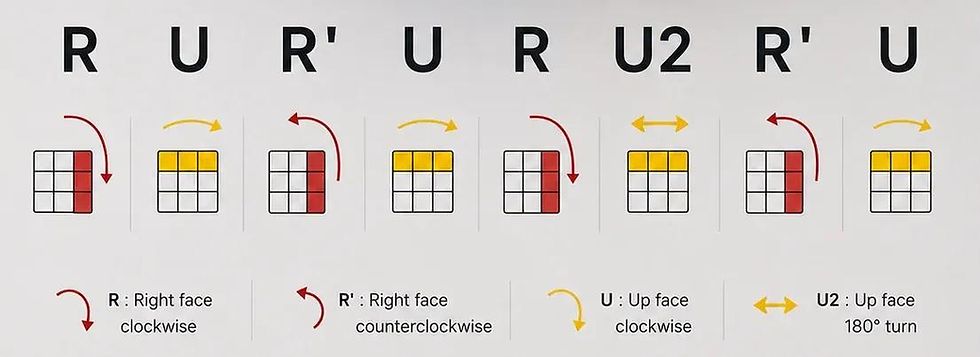
Instead of saying: Turn the right face clockwise, then turn the top face clockwise.


R U
This makes algorithms shorter, easier to read, and easier to memorize.
Most Rubik’s Cube tutorials, speedcubing guides, competitions, and algorithm databases use this notation system. The Six Basic Rubik’s Cube Notation Letters
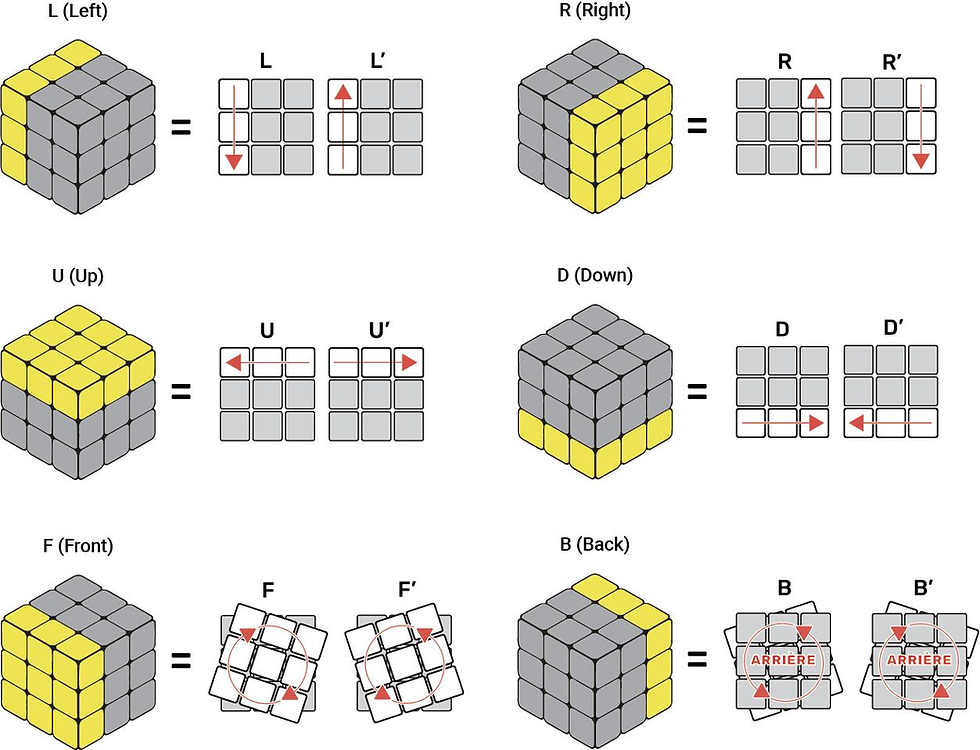
A standard 3×3 Rubik’s Cube has six faces. Each face is represented by a letter.
Letter | Face | Meaning |
U | Up | Top face |
D | Down | Bottom face |
R | Right | Right face |
L | Left | Left face |
F | Front | Front face |
B | Back | Back face |
For example:
R = Turn the Right face once clockwise.
U = Turn the Up face once clockwise.
F = Turn the Front face once clockwise.
The direction is always understood from the perspective of looking directly at the face being turned.


What Does a Prime Symbol (′) Mean?
A small apostrophe or prime symbol ′ means that the face should be turned counterclockwise.
For example:
R′ = Right face counterclockwise.
U′ = Up face counterclockwise.
F′ = Front face counterclockwise.
This is also called an inverse move.
Therefore:
R and R′ are opposite moves.
If you perform R and immediately perform R′, the two moves cancel each other and the cube returns to its previous position.
What Does the Number 2 Mean in Cube Notation?
The number 2 means that the face should be turned 180 degrees, or two quarter-turns.
For example:
R2 = Turn the Right face twice.
U2 = Turn the Up face twice.
F2 = Turn the Front face twice.
A 180-degree turn looks the same whether you turn the face clockwise or counterclockwise.
For example:
R2 = R2′
In normal Rubik’s Cube notation, R2 is sufficient.
Understanding Rubik’s Cube Algorithms
An algorithm is a sequence of Rubik’s Cube moves designed to achieve a specific result while controlling the rest of the cube.
For example:
R U R′ U′
This is one of the most commonly introduced sequences for beginner cubers.
Breaking it down:
R – Right clockwise
U – Up clockwise
R′ – Right counterclockwise
U′ – Up counterclockwise
Reading algorithms one move at a time helps beginners understand what their hands should do instead of trying to memorize a long sequence immediately.
What Are Wide Moves in Rubik’s Cube Notation?
Advanced Rubik’s Cube methods sometimes use wide moves.
A wide move turns two layers together instead of only one outer layer.
You may see notation such as:
Rw
This generally means turning the Right layer together with the adjacent middle layer.
Other examples include:
Uw, Lw, Fw, Bw, Dw
Wide-move notation can vary slightly between tutorials, so it is useful to check the notation system being used by the particular method or instructor. What Are Cube Rotations?
Cube rotations are different from turning a single face. A rotation changes the orientation of the entire Rubik’s Cube.
The three common rotation letters are:
x – Rotate the entire cube as if performing an R move.
y – Rotate the entire cube as if performing a U move.
z – Rotate the entire cube as if performing an F move.
Cube rotations are particularly common in advanced speedcubing algorithms and methods such as CFOP, OLL, and PLL.

What Are Middle Layer Moves?
The three middle-slice moves are:
M – Middle slice, following the direction associated with L.
E – Equatorial slice, following the direction associated with D.
S – Standing slice, following the direction associated with F.
These moves are more commonly encountered in advanced Rubik’s Cube algorithms.
Beginners generally learn the six basic face moves first before adding slice moves to their practice.
How to Read Rubik’s Cube Notation Correctly
The easiest way to learn cube notation is to understand one move at a time.
Consider this algorithm:
R U R′ U′
Do not try to memorize the entire sequence immediately.
Instead, read it as:
Right → Up → Right inverse → Up inverse
Then practice the sequence slowly.
Once your hands become familiar with the movements, gradually increase your speed.
When learning algorithms online, always keep the cube orientation consistent. If the tutorial says to keep the white face on top and the green face in front, maintain that position unless the instructions specifically tell you to rotate the cube.
Why Is Rubik’s Cube Notation Important for Speedcubing?
Rubik’s Cube notation is especially important for speedcubing because it creates a universal way for cubers around the world to communicate algorithms.
A speedcuber can learn an OLL or PLL algorithm from a tutorial without needing lengthy verbal instructions.
Notation also makes it easier to:
Learn new Rubik’s Cube algorithms
Practice CFOP
Understand OLL and PLL
Follow speedcubing tutorials
Record solving sequences
Memorize advanced patterns
Communicate with other cubers
Analyze and improve solving techniques Rubik’s Cube Notation Cheat Sheet
Here is a quick reference for beginners:
U – Up clock wise
Up counterclockwiseU2 – Up 180°
D – Down clock wiseD′ – Down counterclockwiseD2 – Down 180°
R – Right clock wiseR′ – Right counterclockwiseR2 – Right 180°
L – Left clock wiseL′ – Left counterclockwiseL2 – Left 180°
F – Front clock wiseF′ – Front counterclockwiseF2 – Front 180°
B – Back clock wiseB′ – Back counterclockwiseB2 – Back 180°
Frequently Asked Questions About Rubik’s Cube Notation
What does R mean on a Rubik’s Cube?
R means turn the Right face of the cube clockwise by 90 degrees.
What does R′ mean?
R′ means turn the Right face counterclockwise by 90 degrees.
What does R2 mean?
R2 means turn the Right face 180 degrees, which is two quarter-turns.
What do U, D, L, R, F, and B mean?
They represent the six faces of a standard Rubik’s Cube: Up, Down, Left, Right, Front, and Back.
Is Rubik’s Cube notation difficult to learn?
No. Beginners can learn the basic notation quickly by understanding the six face letters, the prime symbol, and the number 2. Advanced notation can then be learned gradually.
Start Learning Rubik’s Cube Algorithms
Understanding Rubik’s Cube notation gives you the foundation needed to progress from beginner solving to advanced speed cubing. Once you understand U, D, L, R, F, B, prime moves, and double turns, you can begin reading and practicing hundreds of Rubik’s Cube algorithms.
The key is to practice slowly, maintain the correct cube orientation, and focus on accuracy before speed. With regular practice, cube notation becomes second nature and opens the door to faster solving, advanced methods, and competitive speed cubing.
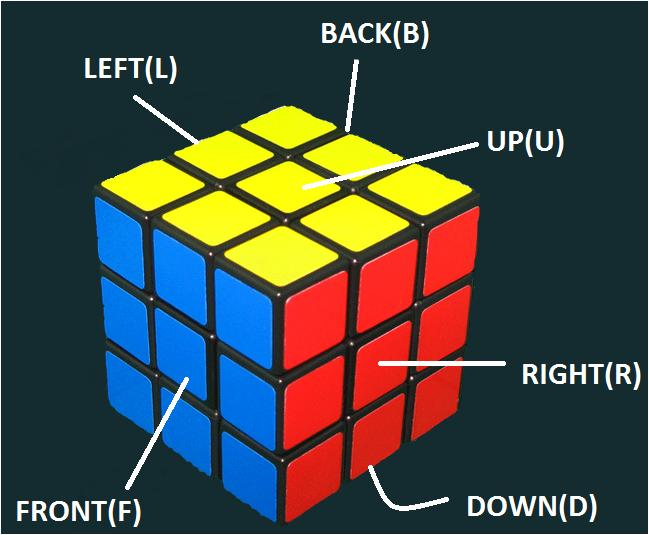


Rubik's Cube notation guide showing R U F L B D moves
The Six Basic Rubik’s Cube Notation Letters
This is probably the most important image in the entire article, because it visually explains U, D, R, L, F and B. Standard notation defines these letters by the cube face position rather than its color.
Six Rubik's Cube notation moves U D R L F B explained


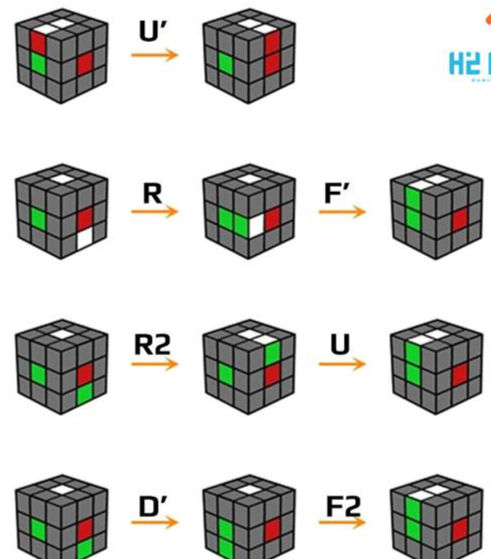
Best placement: After:H2: What Does a Prime Symbol (′) Mean?
and before: H2: What Does the Number 2 Mean in Cube Notation?
R → 90° clockwiseR′ → 90° counterclockwiseR2 → 180° turn
This makes the notation much easier for beginners to understand.
ALT text: Rubik's Cube R R prime and R2 notation explained


Comments