
How to solve a 5x5?
- rsaihelp
- Apr 17
- 2 min read

Step 1: Understanding The Structure
A 5x5 cube has 9 centers on each face, basically a 3x3 center on every face, with a fixed center in between that can be used as a guide for the color scheme. Along with the centers, there’s 3 edge pieces in every edge set, which adds up to a total of 36 edge pieces. The 8 corner pieces on a 5x5 behave exactly like those on a 3x3.
Step 2: Solve All Centers
The reduction method starts by solving one center (which is usually white), and then proceeding to solve the opposite center (yellow). After that, work on the centers in the middle layer. Follow these intuitive tips to make center solving easier!
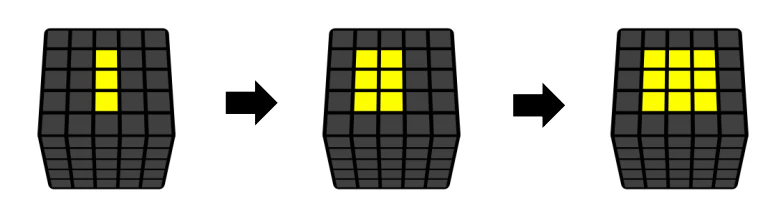
1. Create 1x3 bars of the center pieces and then insert them into their spots by taking the middle center as a reference.
2. Be careful while solving the centers, making sure to not mess up already solved ones.
3. It can be hard to solve centers in the middle layer. Make sure to undo any moves that have messed up the centers you've built up while you were solving.
Step 3: Pair Up All the Edges
We can go on to edge pairing after we've solved all the centers. For each edge, put the three edge pieces together to make one paired edge. It's a good idea to utilize the middle layer to slice and pair the edges and the top and bottom layers to keep the paired edges.
1. Put three edge pieces together in the middle layer, then slice and pair them into one edge.

2. Put the paired edge in the top or bottom layer.
3. Take the slices apart and put the centers back in the middle.

Repeat this process for all 8 edges till the top and bottom layers are filled with paired edges. For the last 4 edges, use the edge flipping algorithm to pair the edges and restore the centers without disturbing anything. A useful tip is to search for instances where one middle edge is already connected to one of the side edges.
For this, you can use the edge-flipping algorithm
R U R' F R' F' R.
This method turns the edge around. You might run into edge parity on the last two edges. To fix this, use the following algorithm:
RW U2 x RW U2 RW U2 RW' U2 LW U2 3RW' U2 RW U2 RW' U2 RW'

Step 4: Solve Like a 3x3
Once you've solved all the centers and paired all the edges, a 5x5 becomes a huge 3x3, and you can solve it the same way you would a standard 3x3.
1. Always undo your slice moves after pairing edges or solving centers.
2. Don’t rush the solve, The 5x5 has much more pieces than a 3x3 so just be careful till you get the hang of it.
With a bit of practice, solving a 5x5 becomes easier and you can then focus on solving it faster! Fortunately, speed solving a 5x5 uses the Reduction Method itself with a few extra algorithms.


Comments